
Bad Execution, Real Costs

A practical guide (to DeFi execution) for digital wallets and fintech platforms
As fintechs add crypto trading and swaps, one question matters more than the number of assets, networks, or liquidity sources they support:Will users actually receive the outcome they were shown?A swap can look competitive at the quote stage but deliver less value, or fail entirely when it is executed onchain. This can easily become a trust issue, leading users to leave your app.
The cost of unreliable execution
When the quoted outcome and the delivered outcome do not match, the impact extends far beyond one transaction.Apps face:
- Lower transaction completion and repeat usage
- Lost volume and fee revenue
- More complaints, investigations, and support costs
- Greater operational and engineering overhead
- Reputational damage and customer churn
- Increased compliance and conduct risk
Users do not distinguish between the wallet, the routing, and the underlying liquidity source. They simply see that the app showed one result and delivered another.At scale, even a small percentage of failed or degraded swaps can become a meaningful cost center.
Why the best-looking quote may not be the best outcome
Most routing systems search available liquidity and select the route that appears to offer the highest return.But not every route behaves consistently between quote generation and execution. A price may move, liquidity may no longer be sufficient, the chosen path may fail, or the transaction may include costs and effects that were not visible in the original quote.
In more serious cases, liquidity can be engineered to look attractive during standard simulation and then behave differently once real capital is submitted.A quote can differ from the final outcome for several reasons:
- Adverse pricing and slippage: the user receives less than expected because the final output or price impact was not properly validated.
- Failed transactions: the route reverts, wasting gas and creating support, operational, and reconciliation work.
- Bad or stale routing: liquidity has changed, the selected path is no longer optimal, or the quote has decayed before execution.
- Unexpected costs: fees or other balance changes only become visible once the transaction settles.
- Policy or compliance failures: transactions reach the chain before internal rules or screening requirements are applied.
- Toxic liquidity: a source presents an attractive result during evaluation, then switches behavior when the real transaction arrives.
- Quote Decay: A quote looks good at N block, but it gets worse over the next.
The causes differ, but the result is the same:
Your app displays an outcome it cannot reliably deliver.
Execution quality is a commercial advantage
Reliable execution helps apps convert more quotes into successful transactions.That directly supports:
- Higher completed volume
- Stronger fee generation
- Better customer retention
- Lower support and operational costs
- Greater confidence from risk and compliance teams
Two apps may offer access to the same assets and networks. The one that delivers more consistent outcomes will create the stronger product experience.
Execution quality therefore becomes a competitive advantage.
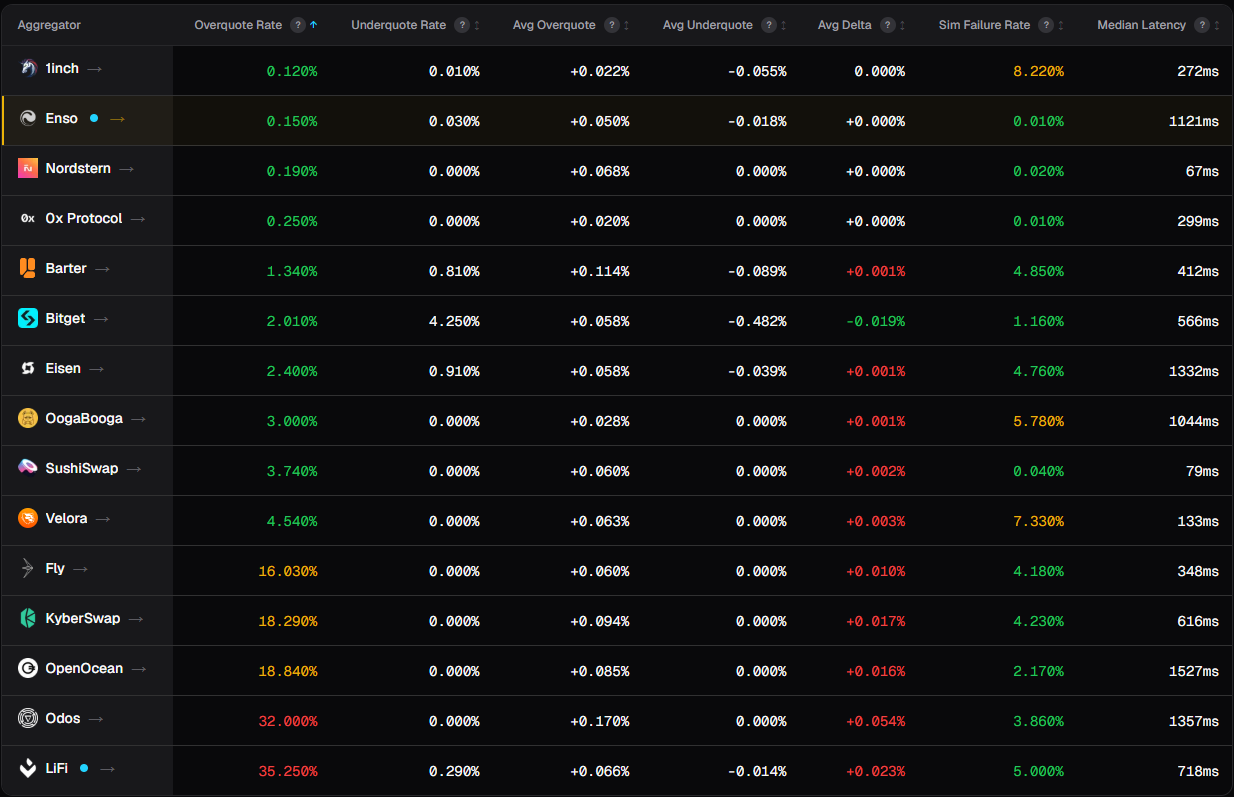
Look at the real-time data yourself: https://shield.enso.build/dashboard
What apps should expect from an execution partner?
A strong partner should do more than connect to liquidity and compare displayed prices. It should be able to:
- Validate whether quoted outcomes are realistically achievable
- Detect liquidity that behaves inconsistently
- Filter routes with elevated execution risk
- Monitor quote and execution differences continuously
- Measure performance across transaction sizes and market conditions
- Give product and risk teams visibility into execution quality
Building these capabilities internally requires specialist engineering, simulation infrastructure, monitoring, historical data, and continuous research.For most wallets and fintechs, that is not the highest-value use of internal resources.
Enso As the Execution Layer
Enso is designed around a simple principle:
Show users an outcome they can realistically expect to receive.
Before presenting a quote, Enso simulates the transaction against the blockchain's live state. This tests the proposed route under current onchain conditions, using the same transaction logic that will be executed with real capital.
The simulation shows whether the transaction is expected to succeed and what the user is expected to receive. Enso continuously compares quoted and simulated outcomes, monitors liquidity behavior, and filters sources that return unreliable or inconsistent results, such as toxic pools.
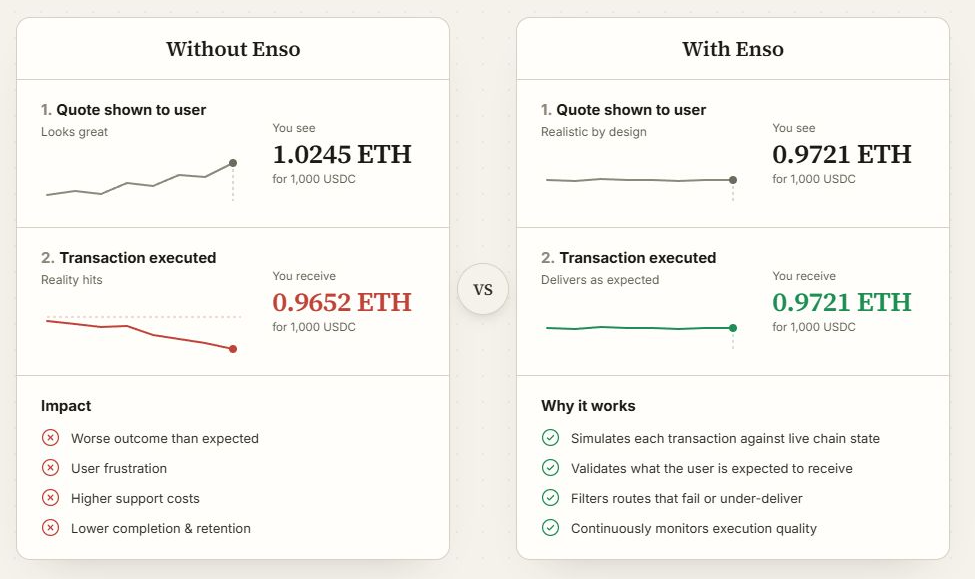
This helps wallets, fintechs, and institutional platforms:
- Increase successful transaction completion
- Protect volume and fee revenue
- Reduce failed and under-delivering swaps
- Lower operational and support costs
- Strengthen user trust
- Launch tokenized products with greater confidence
Reliable execution is what separates a basic integration from a production-grade financial product.
Conclusion
A competitive quote may start a transaction, but reliable, accurate execution is what completes it, generates revenue, and earns the next one.
For apps entering or expanding in crypto, choosing the right execution partner is a decision about conversion, retention, risk, and brand trust.
Enso helps apps deliver the outcomes their users were shown.
Talk to Enso’s BD team to explore how Enso can support your product: https://t.me/lindyhan