
Bridging Is Not the Destination

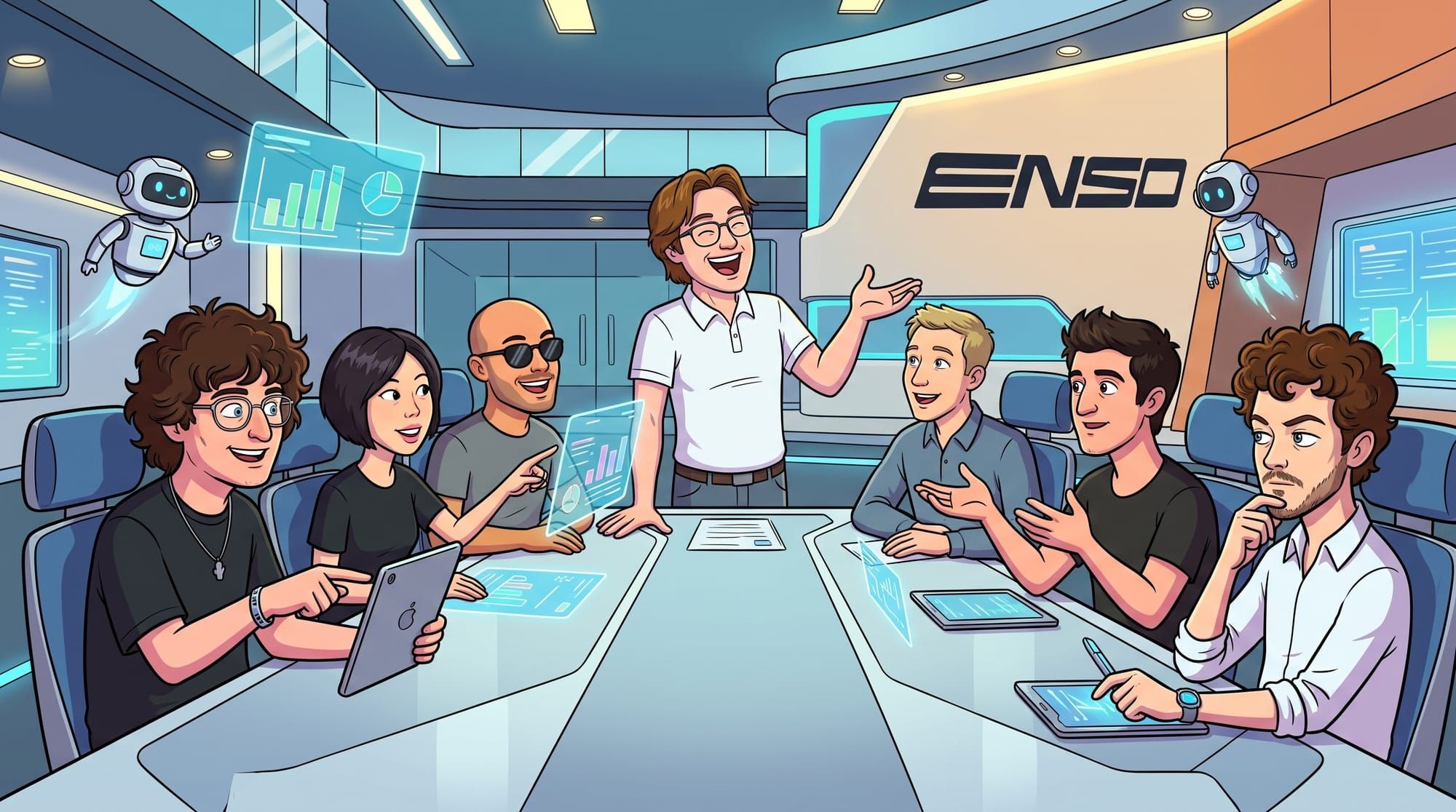
The Enso team on building the Cross-Chain Router and Explorer: why a bridge is only ever half a transaction, why the hardest problem turned out to be a thirty-second window, and why the thing the engineers are proudest of is how simple it ended up being.
We got the engineering team and the commercial team into the same room on a Friday morning (deliberately not a Friday afternoon) to discuss the launch of the Crosschain Router and the Crosschain Explorer.
The conversation that followed was less about a feature set and more about an argument the team has been having internally for a while: that the entire category of "crosschain" is the wrong frame, and that the product's job is to make that frame disappear.
Here is what they said.
A bridge is half a transaction
Ask an engineer at Enso why this release matters and you don't get a feature list. You get a grumble about how the last five years have worked.
"Usually you do a bridge, and doing anything else after the bridge requires further operations. In this way, you can declare a single orchestration flow or intent, however you want to call it, and this gets executed."
— Milos Costantini, CPO
That is the whole thesis compressed into three sentences. Bridging moves an asset. It does not complete the action that the user actually wanted. If you want to swap, bridge, and then deposit into a lending market, or bridge back because you're holding the wrong asset, or send to a centralised exchange, the bridge gets you to the starting line and then hands you a set of asynchronous problems to babysit.
Enso's Crosschain Router collapses that into one declared outcome. You state the destination (the real one, not the chain) and the orchestration runs.
The thirty-second window
The most interesting engineering story in the release isn't the bridging. It's what happens to a quote while you're waiting for one.
Tokenised equities trade on RFQ. When you request a quote, you have perhaps thirty or fifty seconds to execute against it. That window is fundamentally incompatible with a bridge, because a bridge takes an undefined amount of time; on LayerZero it can be minutes.
"If you do a bridge and then the trade, it will fail, because you need to wait for the bridge. And usually it's undefined."
— Milos Costantini, CPO
So the router inverts the order of operations. It doesn't carry a stale quote across the bridge. It waits.
"You bridge, and then only when the funds have landed on the destination chain, a fresh quote gets requested from the providers, and then gets executed. So it's basically with retries as well. It's a way to always get a fresh quote, which results in a decrease in failed transactions, and also allows for retries. Usually, you do a transaction, it fails, and you need to manually retry. In this flow, the Enso operator does X amount of retries within your own set of boundaries - usually the minimum you want to receive from the trade."
— Milos Costantini, CPO
This is the difference between the Router and the cross-chain route widget it evolved from, and the team is precise about what changed:
"Before, you had to define a static trade before the bridge. Now the trade can be dynamic after the bridge."
— Milos Costantini, CPO
And, more fundamentally, who is holding the pen:
"Generally, you ask the bridge to execute. In this new model, we are the one executing the trade."
— Milos Costantini, CPO
That shift is what makes the rest possible: custom gas, multiple quotes, retries, boundaries. You can't customise an execution you've delegated.
What happens when it goes wrong
Every launch post describes the happy path. We asked about the unhappy one.
"The worst that can happen is that the funds get bridged to the intent address and there's a slippage limit where we can't produce a sufficient amount above that threshold. Every intent has an expiration. Once the intent expires, we refund the delivered asset. Eventually, if something goes wrong, it gets refunded."
— Milos Costantini, CPO
No stranded funds waiting on a support ticket. Expiry and refund are part of the design, not the incident response.
"Surprising and suspicious"
We asked what had been much harder than expected. We did not get the answer we were fishing for.
"Everything went smooth."
"We were even talking the other day that it went so smoothly it's surprising and suspicious. But it's really good, and working from the first try.
So... kind of a big win here."
— Enso Engineering
The team's own read on why it went smoothly is more interesting than the fact that it did, and it comes with a caveat attached:
"One of the issues with this system, in general, is that it's too simple. Which allowed us to make it quickly and securely and well, it's very effective. But it also means it can be easily copied by other people. They just don't know yet how it works, but at some point, I think it will be a standard."
— Milos Costantini, CPO
That is an unusually honest thing for a team to say about its own launch. It's also the sharpest argument for why the moat isn't the router.
The moat is the mileage
Asked what another engineering team would underestimate if they tried to build this themselves, Victor didn't point at the architecture. He pointed at the scar tissue.
"The amount of integrations we already have at Enso allows for things that other teams wouldn't be able to do unless they adopt similar technology. And then all the things people on this team have faced: toxic pools, delays between lanes, different timings. All sorts of things. It would take a day to list them. This team has been in the trenches for a while, and all that experience is gathered here."
— Victor, Engineering
The primitive is simple. Knowing every way it breaks in production is not.
The Explorer: one page instead of four tabs
The Crosschain Explorer exists because debugging an orchestrated transaction used to mean a browser full of tabs.
"You can think of the Explorer as an aggregator of information about the route. It gets information from source and destination and the bridging interfaces, and just puts them all together on one page with some additional details. It's not aiming to replace the chain explorers, just to put all the information in one place, so that you don't have to look first on the source chain to find the transaction, which you then reference to the bridge, where you find the destination transaction, which you need to open in another explorer."
— Piotr, Engineering
The team is clear-eyed about what it is and isn't. Block explorers are scoped to a single chain or a single bridge. Enso's Explorer is scoped to the route, and it's built for investigation and demonstration, not for every transaction. Partners consuming status programmatically use the API and render it in their own interfaces.
"The concept of crosschain is outdated"
The strongest opinion in the room wasn't about the product at all.
"I think the idea of something cross-chain is broken itself. It was relevant years ago. But now, with applications like Hyperliquid, Lighter, FOMO, people think mostly about applications, and not about which chain the funds are on. The concept itself of cross-chain is outdated, in favour of a more user-experience-friendly thought process. 'I want to move my funds from Polymarket to Hyperliquid.' 'I want to trade dollars into equities.' I don't want to know which chains or liquidity sources my funds move through."
— Milos Costantini, CPO
Another engineer put it less diplomatically:
"I could rant about this for hours, but bridges should not exist in the first place. It needs to be abstracted in a way that the user doesn't even know it goes through any cross-chain action."
— Enso Engineering
The distinction the team draws is between two audiences. DeFi natives still want the full flow visible, which is what the Explorer is for. Everyone else wants the chain to vanish:
"Users go there and trade dollars into equities. They don't know that under the hood the dollar goes from Optimism to Ethereum and mints there. The only thing they see is dollar to equity. For developers, it's orchestration that can have multiple use cases. For applications, a lot of the time it's UX -abstracting the chain away from the user. Enso is orchestrating these trades."
— Milos Costantini, CPO
The commercial read
Lindy Han, who spends her days on the other side of this conversation, sees the market arriving at the same place from a different direction.
"Two years ago there were many chains, and then L2s just sprouted out like rabbits. It used to be a selling point if you were able to bridge across 20 to 30 chains. But nowadays the assets are consolidated in maybe fewer than five chains, and a few enterprise chains."
— Lindy Han, Business Development
Which does not mean bridging goes away. It means the reason for it changes.
"You're not going to be able to run away from having chains and bridges, because it is a fact of life that everybody wants to own stuff. Different banks are just going to have their own chains, and they want to keep their assets on their own chains. And that necessarily requires some kind of cross-chain action."
— Lindy Han, Business Development
And it clarifies where the differentiation actually sits:
"Where I see Enso's key selling point is not just the crosschain functionality, but the ability to execute transactions. It's not just that you bridge assets from one chain to another; it's what happens after that. You want to use those funds to deposit somewhere, or to buy a separate token. You're linking it up to another new transaction, which a bridge will not be able to do. That is where I see our main strength: in making all these custom flows happen."
— Lindy Han, Business Development
Her summary is the one we'd put on the poster:
"The TLDR is that we enable you to do things that you previously wouldn't have thought possible."
— Lindy Han, Business Development
Where this goes
Asked where cross-chain infrastructure lands over the next two years, the answer was consistent and slightly anticlimactic, which is rather the point.
"I think about it being a layer invisible to the users. In two years, retail users should not even know what tool is used."
— Enso Engineering
Infrastructure that works is infrastructure nobody talks about. The Crosschain Router is a bet that the winning move is to stop asking users to think about chains at all, and the Explorer is the acknowledgement that the people building on top of it still need to see every step.
The Cross-Chain Router and Cross-Chain Explorer are live now: Docs
With thanks to Milos, Piotr, Victor, Brendons, Joaquin, Michele, Javier, and Lindy Han.