
How Altura Unlocked Cross-Chain Distribution for a HyperEVM-Native Vault

50% of total deposits routed into Altura are cross-chain; Altura's vault lives on HyperEVM. Its depositors do not.
That creates a distribution problem:
How do you make a single-chain vault accessible from every chain where users already hold capital?
That mismatch determines whether a vault can only absorb deposits from its native chain or pull capital from every chain its users already sit on. Altura solved it by plugging into Enso. The result is a single-chain yield product that behaves like a multi-chain TVL magnet, with $20M in routed deposits to show for it.
“Most stablecoin holders aren't on HyperEVM. Working with Enso lets us reach them where they already are, without asking them to bridge first." — Louie Rice, Altura
This case study is for web3 wallets, vault managers, asset managers, and liquidity providers asking the same question Altura asked: How do I make my vault depositable from everywhere capital already exists, without writing bridge code, signing distribution deals one-by-one, or rebuilding execution infrastructure for every origin chain?
The Opportunity
Altura is a multi-strategy yield issuer on HyperEVM. The vault is the product, capital comes in, Altura dynamically allocates it across yield strategies, and depositors hold a single position on a single chain.
The challenge for any yield issuer is distribution.
A vault deployed on one chain is naturally limited to users already on that chain, unless someone builds the execution layer that connects external capital to the product.
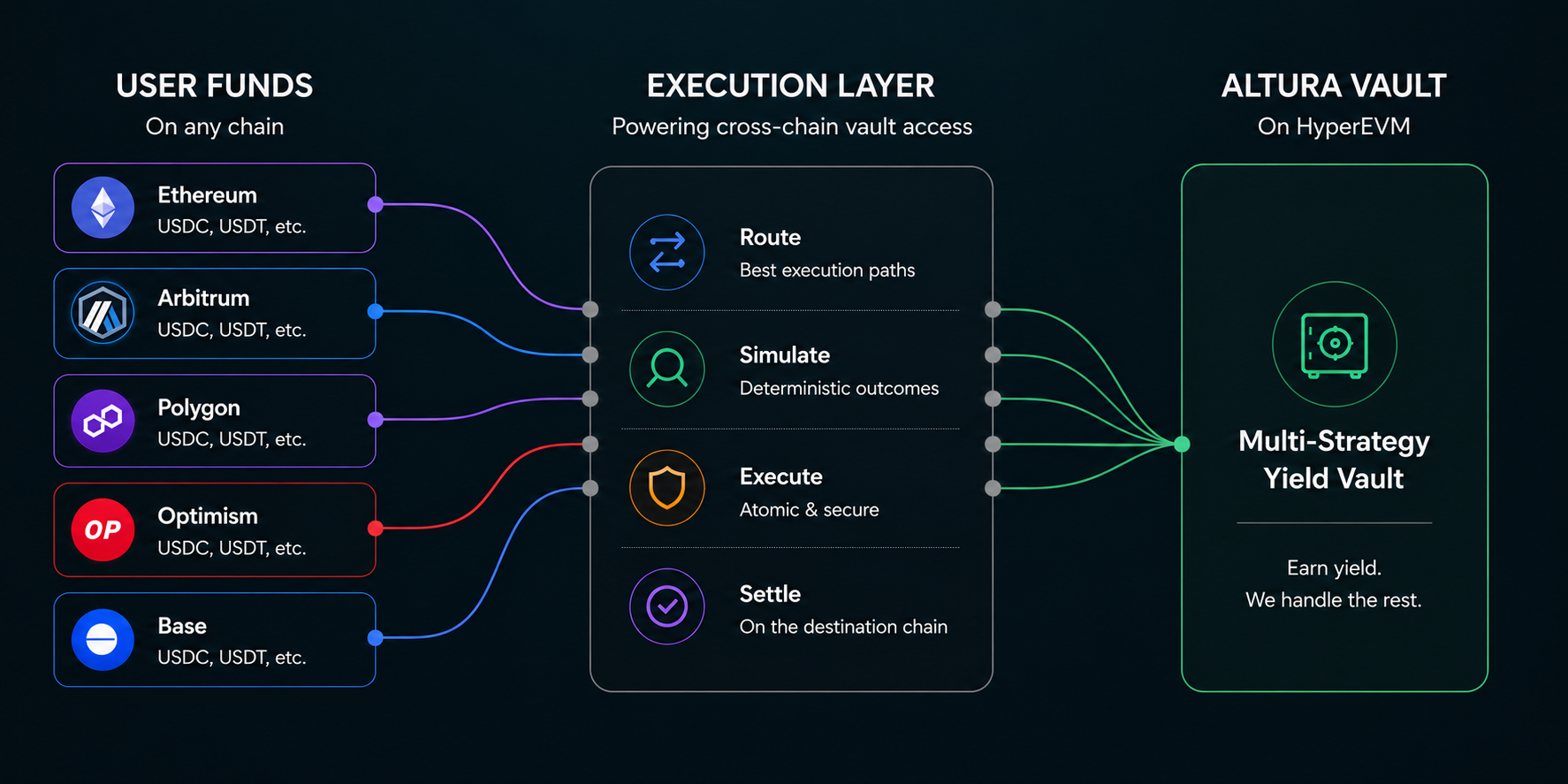
Every step of friction between a holder's existing balance and the deposit is TVL the vault never sees. For an Earn product to grow, the work between "I want yield" and "I'm earning yield" has to disappear.
For the depositor, the only remaining question should be:
How much do I want to deposit?
The Challenge
A user with USDC on Ethereum cannot directly deposit into a HyperEVM-native vault. In practice, the path is five steps:
1. Bridge assets from Ethereum to HyperEVM.
2. Convert into the supported vault deposit asset.
3. Mint Altura vault shares on HyperEVM.
4. Bridge the resulting position back to the origin chain.
5. Track exposure across chains.
Every step is a place the deposit can fail, stall, or be abandoned. Altura needed full-path execution, not just routing. At this point, Altura had an access problem: the capital it wanted to attract was spread across chains, while the vault lived on HyperEVM.
The Solution
Altura uses Enso Earn to power cross-chain minting end-to-end.
Enso handles the round-trip path as one coordinated operation:
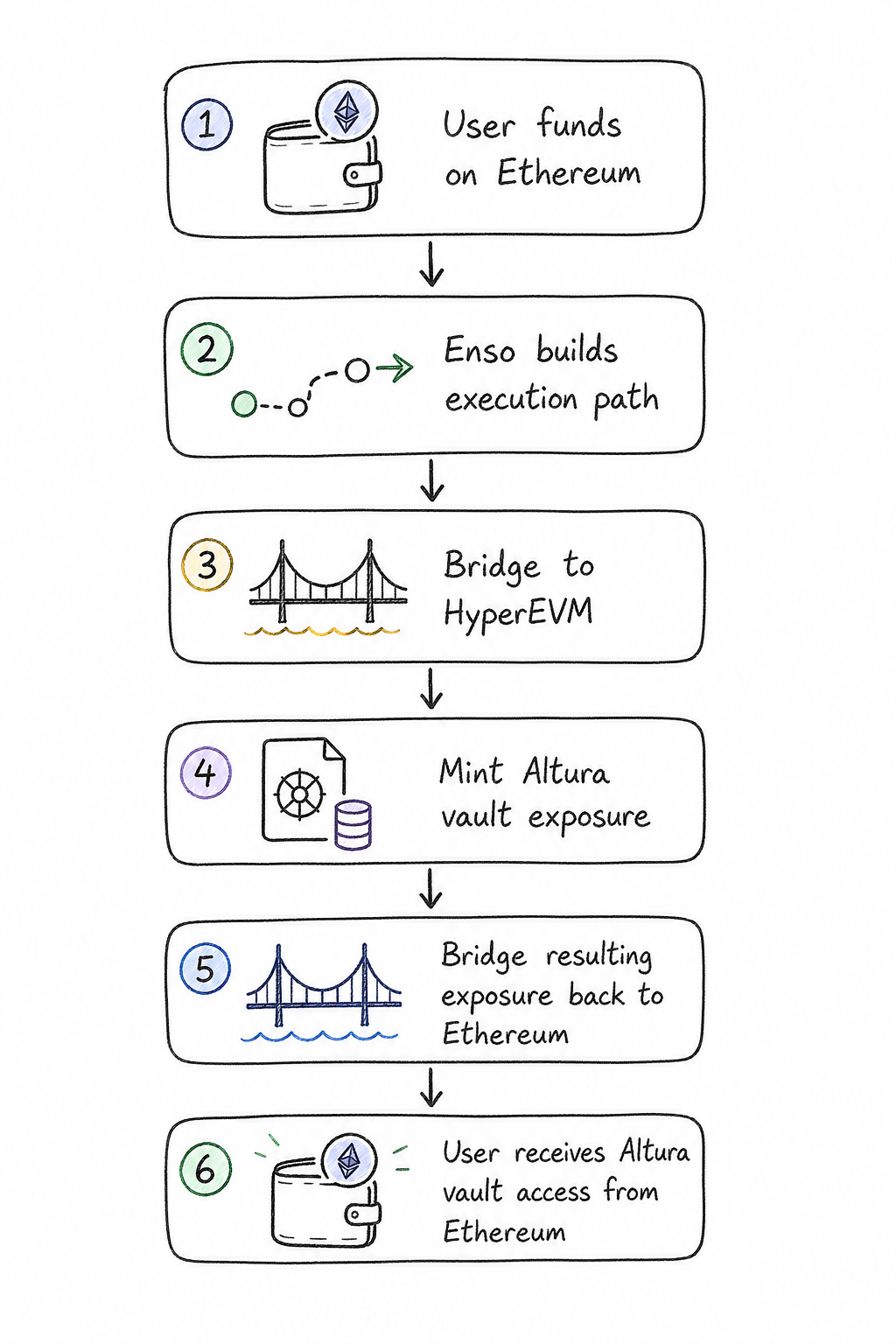
Enso routes the bridging, executes the mint on HyperEVM, settles the position back to the user's origin chain, and accounts for the cross-chain state along the way.
The user signs once on the chain where they already hold capital. They get a settled position. Altura gets a vault deposit through its native HyperEVM environment. Neither side has to manage the cross-chain plumbing directly; Enso coordinates it.
Enso as Distribution Infrastructure
Altura's own frontend is the only deposit surface, but now every wallet, asset allocator, embedded-finance app, or liquidity provider can also serve as a distribution channel for Altura's vault.
Wallets, yield aggregators, incentive platforms, embedded-finance products, allocator interfaces, and other DeFi applications routing through.
Enso can all become deposit surfaces for Altura. For a vault issuer, this means:
- TVL from distribution surfaces you do not have to source.
- Depositors you would never have reached one-by-one.
- A network of inlets that grows every time Enso ships a new integration, without Altura doing the work.
Results
- Altura reached $20M TVL, with half of those deposits being cross-chain.
- Origin chains include Ethereum, Arbitrum, Polygon, Optimism, and Base, capital that would otherwise be inaccessible to a HyperEVM-native vault.
- Zero failed deposit flows across tracked Enso-routed executions.
“What matters to us is that the deposit just works. A cross-chain flow that fails halfway is the fastest way to lose someone's trust, so we needed an execution layer we can rely on every time." — Louie Rice, Altura
Strategic Takeaway
The next generation of Earn products will compete on distribution.
By plugging into Enso, Altura turns a single-chain vault into a chain-agnostic yield product that can continuously source deposits from wherever user capital already exists.
That means:
- More reachable TVL.
- More deposit surfaces.
- More distribution without additional integration overhead.
Altura's frontend is only one entry point.
Wallets, DeFi yield platforms, embedded-finance apps, allocator interfaces, incentive systems, and other third-party products integrated with Enso can also route deposits into Altura through Enso Earn.
Every new Enso integration becomes another potential capital inlet for the vault.
Instead of sourcing deposits chain-by-chain and integration-by-integration, issuers can plug into a shared execution and distribution layer that continuously expands, from which deposits can originate.
And because Altura's vault shares are chain agnostic, additional DeFi markets can be deployed wherever demand exists, whether through Pendle markets, Morpho vaults, lending integrations, or other liquidity venues across chains.
Issuing a vault, structured product, or earn strategy?
Talk to Enso BD about plugging into our distribution network: @lindyhan Building the integration?
Read the docs: docs.enso.build