
xStocks brought equities onchain. Enso brings them to your users.

Now that xStocks has brought tokenized equities onchain, Enso's infrastructure is putting them to work.
At Enso, we identified that while tokenization has solved supply, the distribution gap remains to be fixed. We reached the stage where the inventory of credible real-world assets was on-chain, and while there was both custody and demand, the missing piece was the rail that lets any app, wallet, or fintech actually offer those assets to its users under the required controls, without rebuilding the stack from scratch.
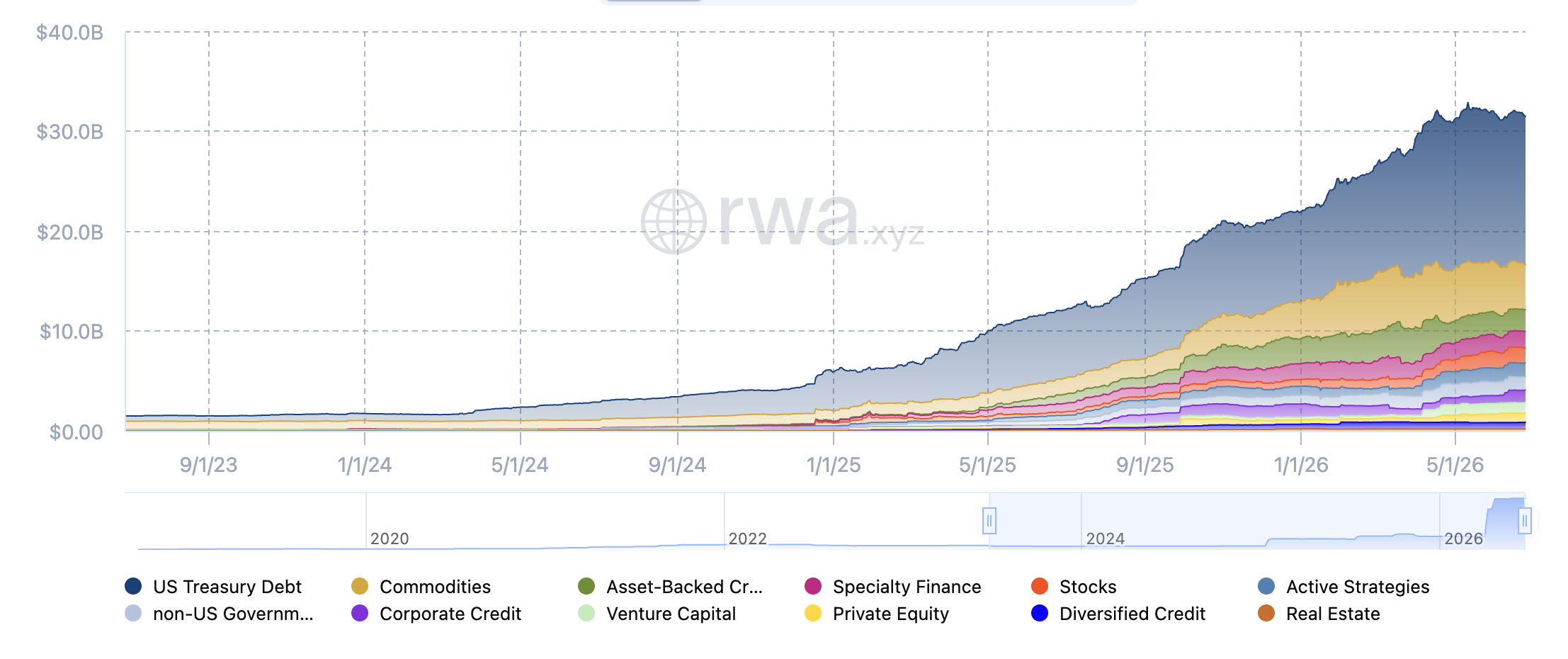
Today we're sharing how we’ve filled this gap for two of the most important real-world asset categories: tokenized U.S. equities and ETFs by supporting xStocks on Enso.
So what are xStocks?
xStocks are tokenized versions of U.S. stocks and ETFs: AAPLx, NVDAx, TSLAx, SPYx, and a growing catalog of other household names. Each token is backed 1:1 by the corresponding underlying stock or ETF, held by the issuer, and made available to eligible users as a wallet-native, fractional, freely transferable token on supported chains and venues.
What they give users:
- Familiar public-market exposure, from Apple, Nvidia, and Tesla, through to the S&P 500, all accessed inside the same wallet they already use for crypto.
- Fractional position sizes.
- 24/7 trading on supported venues.
- The ability to use those positions in DeFi as collateral, liquidity, or strategy inputs, where protocols support it.
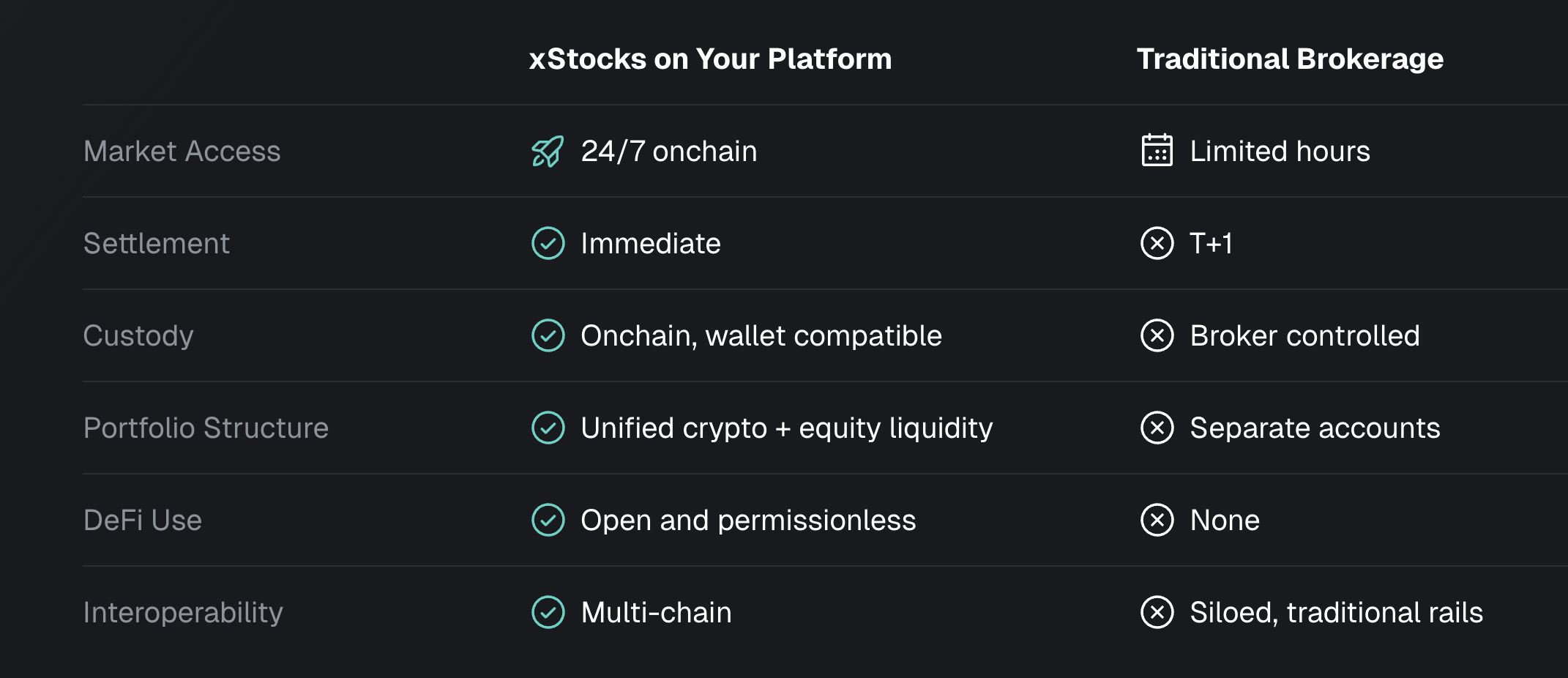
The category has scaled fast. xStocks have crossed $37B in cumulative transaction volume to date, and the broader tokenized equity holder base has grown from roughly 1,500 in late 2024 to over 185,000 today.
Why this matters for the apps building with Enso
Wallets, neobanks, and crypto-native frontends are all hearing the same feedback from their users: they want public-market exposure inside the product they already use, not in a separate brokerage app.
That demand has the potential to unlock a new vertical for these platforms, and with it, new revenue surfaces around routing, fees, structured products, lending, collateral, and liquidity. Users who can buy AAPLx or SPYx without leaving the app don't need to be re-acquired elsewhere, increasing customer lifetime value and deepening engagement.
But listing tokenized stocks is not enough. The hard part isn’t whether the asset exists; it’s getting a user who is holding USDC, ETH, or SOL on whatever chain they happen to be on into the xStock they want, through the supported path, under the issuer's rules.
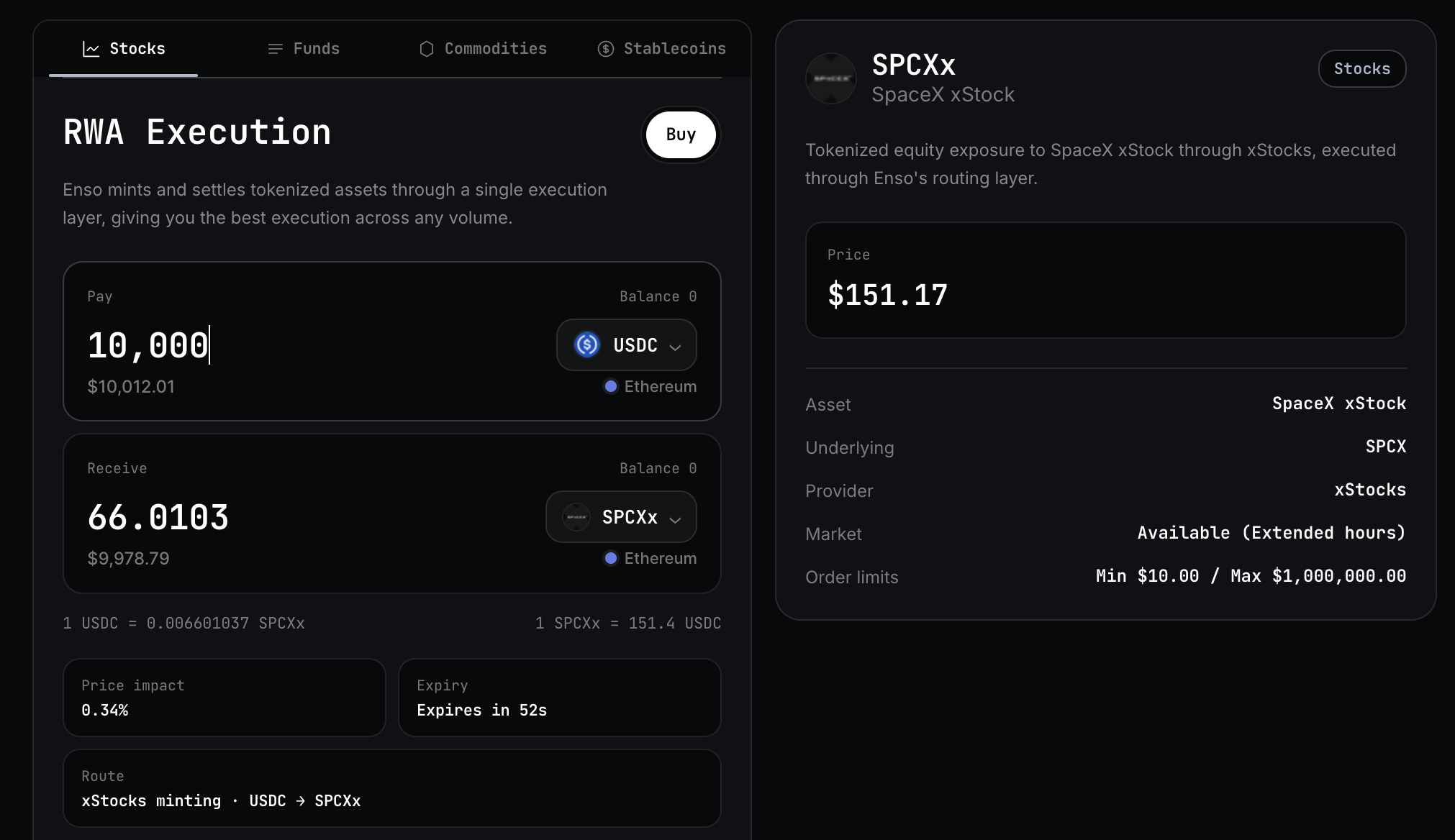
That path involves routing logic, RFQ paths, issuer constraints, min/max order rules, liquidity venues, and transaction construction. Building and maintaining all of that is a serious engineering investment. That's months of engineering work most apps can't afford.
What Enso delivers
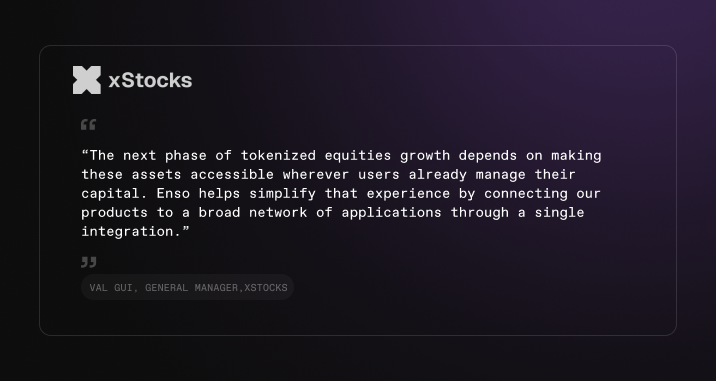
Enso is the execution layer between supported tokens and xStocks. Partners integrate Enso once and let their users route into supported xStocks through whatever path is available at the time.
Concretely, that means:
- No bespoke xStocks routing build.
- No need to integrate every liquidity venue or RFQ path directly.
- Access to the best available supported route across Enso's execution layer.
- A cleaner way to expose tokenized equity access inside the partner's own UX.
- The partner keeps the customer relationship, the policy controls, and the economics.
At launch, this is same-chain execution against supported xStocks venues. Enso is the execution layer, not the issuer, so xStocks issuance, custody, and legal eligibility sit with the issuer. We help partners source the best available supported route into xStocks; we don't guarantee the best price.
That precision matters because the operators we work with require it. Soft promises don't ship in regulated environments.
The bigger vision
As DeFi protocols add support for tokenized equities, users will want to do more than hold them. They’ll want to:
- Borrow against them.
- Supply them as liquidity.
- Route between tokenized equities and other on-chain assets.
- Deposit them into structured products.
- Combine them with yield strategies.
Each of those flows is a separate integration if a partner builds it themselves. Through Enso, they are a single execution layer that grows as the ecosystem grows. A wallet that integrates Enso for the trade flow today gets the borrow, supply, and route flows tomorrow, without a new integration each time.
That is what we mean when we say xStocks makes equities programmable, and Enso makes that programmability usable. The asset exists, but execution to make it useful has been missing until now.
What's next
More tokenized assets, more distribution partners, and more ways for users to access capital markets directly from the products they already use.
If you’re building a wallet, neobank, or fintech, Enso lets you bring tokenized equities to your users through a single integration.